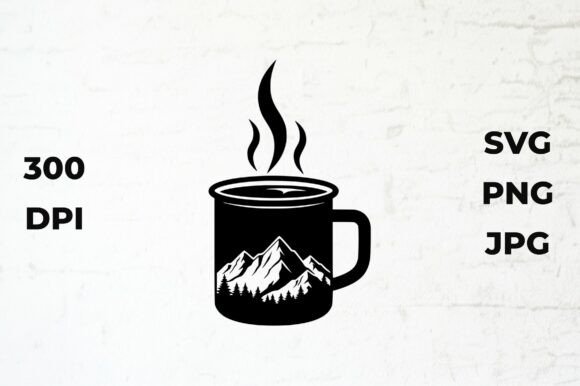
Coffee Cup Steam Mountain Silhouette
As a designer who’s stitched hundreds of custom projects—from boutique aprons to Etsy embroidery kits—I opened Coffee Cup Steam Mountain Silhouette expecting charm. What I got was something sharper: a quiet, confident graphic that feels both nostalgic and intentional. It’s not just “coffee + mountains.” It’s steam curling like a breath in cold air, a mug grounded with clean negative space, and a mountain range that reads clearly even at 2.5 inches tall. That matters—especially when you’re planning a real embroidered tote bag for a local hiking co-op or stitching a baby onesie for a trail-running parent.
First Impressions: Mood, Shape, and Real-World Fit
The silhouette layout is smartly balanced—no heavy bottom weight, no fussy details that’ll vanish under thread. The steam rises with gentle rhythm, not rigid symmetry, and the mountain line has just enough variation to feel hand-drawn but not chaotic. It lands squarely in the “outdoor adventure meets cozy ritual” sweet spot—a mood that resonates with craft businesses selling personalized sweatshirts, camp-themed nursery decor, or handmade kitchen towels for coffee-loving customers.
I immediately pictured it on a natural linen tea towel: medium-density fill stitch for the mug, satin stitch for the outer rim, and a light running stitch tracing the mountain peak. On fabric, this design won’t shout—it’ll invite. That’s valuable when your finished product needs to feel considered, not cluttered.
Where It Shines (and Where It Needs Care)
Coffee Cup Steam Mountain Silhouette works beautifully on stable, medium-weight fabrics—think cotton twill for embroidered patches, midweight fleece for sweatshirt embroidery, or canvas for tote bag design. Its clean lines hold up well in satin stitch borders and read clearly in small hoop sizes (3.5–4 inches), especially when paired with a lightweight cutaway stabilizer.
It’s also a strong candidate for baby embroidery—soft, non-gendered, and meaningful without being cutesy. Stitched in heather gray thread on an organic cotton onesie? Calm. Thoughtful. Shareable.
But here’s where attention matters: avoid using it on highly textured fabrics (like bouclé or thick terry) without testing stitch density first—the steam detail can blur. On stretchy fabric (e.g., performance tees), stabilize aggressively and consider simplifying the steam into two or three distinct curves instead of one continuous swirl. And on dark fabric? Confirm your thread colors have enough contrast—not just for visibility, but for perceived value. A charcoal mug on black fabric reads as “missing detail,” not “minimalist.”
Commercial Use Reality Check
If you’re an Etsy seller or small shop owner building a cohesive collection—say, a “Trail Brew” line of embroidered caps, mugs, and patches—Coffee Cup Steam Mountain Silhouette adds instant thematic cohesion. It’s versatile enough to scale across products without feeling repetitive. But remember: as a digital embroidery file, its strength lies in consistency *across* items—not uniqueness *within* one. Don’t lean on it as your only mountain-themed asset; pair it with complementary elements (a pine branch motif, a simple compass icon) to build depth.
For holiday embroidery or wedding gifts (think “his & hers” camping-themed robes), it reads warmly—but only if stitched cleanly. Customers notice when steam looks lumpy or the mug handle loses definition. That’s why I always test Coffee Cup Steam Mountain Silhouette on scrap fabric first: checking how fill stitch settles in corners, whether the steam’s taper holds at low density, and how the overall shape anchors on curved surfaces like cap fronts.
Design Assets That Earn Their Place
This isn’t a “throw-it-on-and-go” embroidery file. It’s a design asset that rewards thoughtful execution. As a Graphics product, its SVG, PNG, and JPG files give flexibility—you can tweak sizing for printable mockups or adapt outlines for applique design. But vector doesn’t equal automatic embroidery readiness. Before digitizing, ask: Does the steam’s narrowest point clear 0.8mm? Will the mug’s base anchor firmly on a curved pillow cover? Does the mountain silhouette retain character when reduced for a baby cap?
I’ve seen this design misused on layered garments (like reversible zip hoodies), where the steam gets lost between fabric layers. It also struggles on ultra-thin fabrics (e.g., rayon challis) without tear-away backing—and on heavily washed items (like kitchen towels), where dense fill areas may pill faster than open-stitch alternatives.
Practical Notes Every Embroidery Designer Should Keep Handy
- Test Coffee Cup Steam Mountain Silhouette on your actual fabric + stabilizer combo—not just generic cotton swatches.
- Check thread color contrast on both light and dark backgrounds before finalizing your commercial embroidery project.
- Review stitch density: high density fills look rich on tote bags but stiff on baby embroidery—adjust accordingly.
- Confirm hoop size compatibility early—this design scales well, but tiny versions (under 2 inches) lose steam definition.
- Inspect small details in black-and-white mockups. If the mountain line disappears in grayscale, it’ll struggle in monochrome thread.
- Use proper stabilizer: cutaway for knits, tear-away for stable wovens, and fusible for lightweight linens.
- Verify licensing terms before selling finished products or bundling Coffee Cup Steam Mountain Silhouette into digital embroidery kits.
Ultimately, Coffee Cup Steam Mountain Silhouette earns its place in a craft business not because it’s trendy—but because it’s reliable. It communicates warmth and wanderlust without overpromising. It stitches cleanly, sells thoughtfully, and fits naturally into handmade product lines that value authenticity over flash. For embroidery designers, Etsy sellers, and creative entrepreneurs building real-world goods—not just pixels—this is the kind of Crafts asset that quietly lifts the whole collection.