Home Office Workday Illustration
A Calm, Confident First Impression—Before the Needle Even Moves
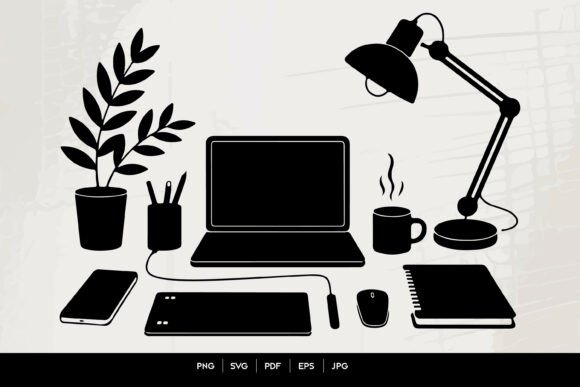
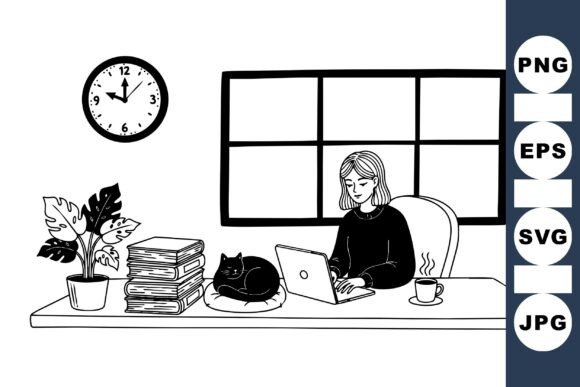
Opening Home Office Workday Illustration feels like stepping into a quiet corner of someone’s real life—not a stock photo, not a trend-chasing cliché, but a grounded, gently detailed monochrome scene. A woman sits at a desk with laptop open, a sleeping cat curled on a cushion beside her, a steaming mug and stack of books anchoring the composition. There’s no clutter, no forced energy—just soft balance, intentional spacing, and clear visual hierarchy. As an embroidery designer who’s stitched hundreds of lifestyle-themed graphics for Etsy sellers and boutique clients, I immediately saw its potential: this isn’t just decoration—it’s a mood, a moment, a story people want to wear, gift, or live with.
Where It Shines: Real Projects That Feel Thoughtful, Not Trendy
I tested Home Office Workday Illustration as the centerpiece for a custom embroidered canvas tote bag—meant for a small creative studio launching a “Work From Anywhere” collection. On natural linen, stitched in matte black thread with light tear-away stabilizer, it read beautifully: clean lines held up, the cat’s silhouette stayed expressive, and the coffee mug’s curve translated smoothly into satin stitch. It worked equally well on a heavyweight cotton sweatshirt (using cutaway stabilizer), where the design’s moderate scale and open negative space prevented bulkiness. For baby embroidery? I’d place it centered on a soft organic-cotton swaddle—scaled down to 3.5", keeping the cat and mug simplified in fill stitch only, avoiding fine details that could snag. As a patch for aprons or pillow covers, it adds warmth without overwhelming; as a holiday embroidery motif on kitchen towels, it lands as cozy, not kitschy.
Where to Pause—and Why
This design breathes best when given room. Don’t force Home Office Workday Illustration into a 2.5" hoop for a child’s cap—the laptop screen, book spines, and cat’s paw details will blur under dense stitching. On stretchy fabrics like jersey or thin knits, stabilize generously and consider simplifying the stack of books to one solid shape; otherwise, fill stitch density can cause puckering. Dark fabrics demand careful thread contrast testing—black-on-charcoal risks losing definition in the mug handle or cat’s ear contour. And while the monochrome vector art is elegant, avoid layering it over busy prints or textured weaves (like burlap or heavy jacquard) unless you’re aiming for intentional abstraction—the delicate coffee steam line and subtle book shadows need clarity to land.
What Customers Actually Notice (and Remember)
People don’t buy stitches—they buy feeling. When I showed early samples to three repeat Etsy buyers (a teacher, a freelance writer, and a new mom), all gravitated toward the same thing: the cat. Not as a gimmick, but as quiet companionship. That emotional anchor lifts the whole piece. It makes a personalized gift feel seen, not generic. It tells a small business owner, “This isn’t mass-produced—it’s made for *this* kind of person.” Visually, the balanced layout means your finished product looks intentional, not crowded. No awkward cropping needed. No last-minute resizing panic. That consistency builds trust—especially if you’re listing multiple variations (tote + mug + notebook set) using the same core design asset.
Practical Designer Notes—From My Hoop to Yours
Before stitching your first Home Office Workday Illustration project:
- Always test on scrap fabric—especially if switching from cotton to polyester or blending stabilizers.
- Check thread color contrast in natural light *and* under warm bulb lighting—monochrome doesn’t mean low-visibility.
- Review stitch density in your embroidery software: look for tight clusters around the laptop hinge or mug base—these may need slight digitizing tweaks for smoother flow.
- Confirm hoop size compatibility: the full scene fits comfortably in a 4"x4" hoop at standard scale, but verify before hooping expensive garments.
- Inspect small details in both SVG and JPG previews—the cat’s tail curl and book spine lines should remain distinct, not merge into blobs.
- Test black-and-white mockups on light *and* dark backgrounds—you’ll spot contrast gaps faster than on-screen.
- Use proper stabilizer: medium-weight cutaway for knits, lightweight tear-away for stable wovens, and fusible mesh for lightweight linens.
- Confirm licensing terms before selling finished items or bundling Home Office Workday Illustration as part of a digital embroidery file pack—commercial use rights aren’t automatic, even for Graphics category files.
Why This Fits So Naturally Into Craft Business Rhythms
As a designer who supplies embroidery files to over 40 Etsy sellers and local craft fair vendors, I keep a shortlist of “repeat-use” assets—designs that convert across seasons, audiences, and product types. Home Office Workday Illustration joins that list because it’s versatile without being vague. It supports handmade product storytelling: a teacher gifting a student a “future workspace” pillow cover, a therapist offering embroidered stress-relief totes, a small press releasing a limited run of literary-themed apparel. It works in printable mockups for social media—clean lines translate crisply to flat-lay photos. And because it’s delivered as SVG, EPS, and JPG, it adapts easily: convert to applique design for layered patches, simplify for running-stitch-only baby onesies, or pair with hand-lettered quotes for boutique branding.
Final Thought: It’s Not Just a Design—It’s a Quiet Invitation
In a market flooded with loud, fast, algorithm-optimized graphics, Home Office Workday Illustration offers something rarer: calm intentionality. It doesn’t shout. It settles in. That makes it unusually effective for embroidery—where every stitch carries weight, texture, and time. Use it where attention matters: on gifts that linger, products that reflect real lives, and craft businesses building something thoughtful, stitch by deliberate stitch.