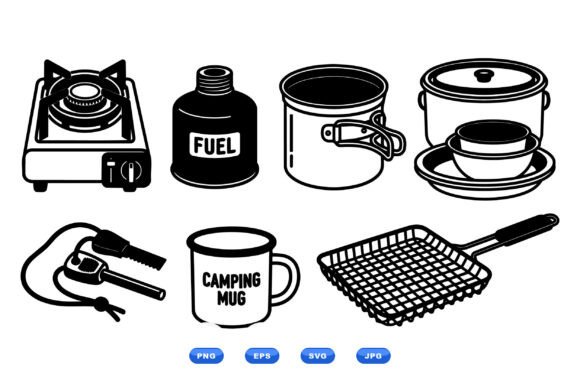
Camping Cookware Clipart Pack
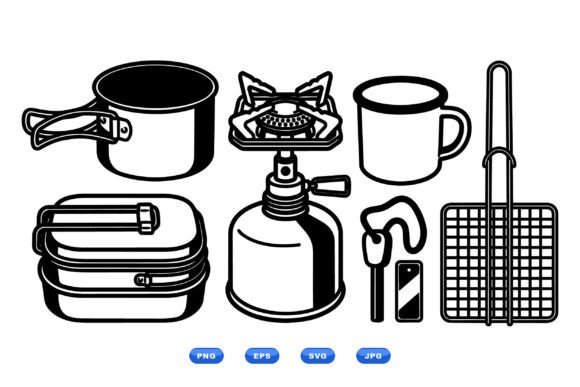
As someone who’s digitized, stitched, and sold hundreds of embroidery designs—from nursery motifs to boutique apparel—I opened the Camping Cookware Clipart Pack expecting clean line art, but what stood out immediately was its quiet confidence. It doesn’t shout “outdoors!” with pine trees and roaring campfires. Instead, it offers a portable gas stove, a simple mug, and a nested lunchbox—rendered in uncluttered, single-weight line art. That restraint is its strength. It feels intentional, not generic—a design that breathes on fabric instead of fighting it.
This Isn’t Just Clipart—It’s Embroidery-Ready Mood
The Camping Cookware Clipart Pack lands somewhere between rustic charm and modern minimalism. No shading, no gradients, no busy outlines—just smooth, continuous strokes with gentle curves and purposeful negative space. That makes it unusually versatile for real embroidery work. I immediately pictured it stitched on a heavyweight cotton tote bag for a local outfitter: subtle enough for adults who dislike “cute,” bold enough to read clearly at 3 inches wide. It also clicked as a soft accent on a baby onesie—paired with tiny mountain silhouettes or a simple “Adventure Starts Here” banner—because the shapes are friendly without being childish.
What surprised me was how well it translated to small-scale applications. The mug handle, stove burner rings, and lunchbox latch are all drawn with enough clarity to survive a 2-inch hoop without collapsing into thread mush. That’s rare in line-art packs, where details often vanish under satin stitch or get lost in fill density. Here, the lines hold their character—even when scaled down to 1.5 inches for a cap front or embroidered patch.
Where It Shines (and Where to Pause)
In practice, the Camping Cookware Clipart Pack excels in projects where authenticity and subtlety matter: custom sweatshirt embroidery for outdoor educators, tea towel sets for a craft fair booth, linen pillow covers for a cabin rental brand, or personalized aprons for a small-batch food truck. Its minimalism lets the stitching quality—not the design complexity—carry the impression. On medium-weight fabrics like twill, canvas, or midweight cotton, the lines translate cleanly using running stitch or light satin stitch, with excellent legibility and no need for heavy underlay.
That said, proceed thoughtfully on stretchy or textured fabrics. A ribbed knit sweatshirt will soften the crispness of those stove lines unless you add light cutaway stabilizer and reduce stitch density slightly. And while the design avoids fine interior details (no tiny rivets or engraved text), the narrow gap between the nested lunchbox layers could blur on very dense fill stitch—or vanish entirely if digitized too aggressively. Always test on scrap fabric first, especially if planning a commercial embroidery run.
Dark fabric? It works—but only if you choose high-contrast thread colors. A charcoal grey mug outline on navy twill reads beautifully in white or cream thread, but beige-on-black disappears. Likewise, avoid placing it near curved seams or deep pockets on tote bags unless you’ve confirmed your hoop clears the seam allowance. And skip ultra-thin fabrics like voile or lightweight rayon unless backing it with tear-away + topping—it’s line art, yes, but thin lines still need support to stay crisp.
More Than a Graphic—It’s a Branding Tool
For Etsy sellers and small shop owners, the Camping Cookware Clipart Pack isn’t just another digital embroidery file—it’s a quiet branding asset. Unlike overdesigned camping motifs, this pack supports cohesion. Use the mug alone on a holiday kitchen towel, pair the stove with a “Campfire Coffee” script for a printable mockup, or layer the lunchbox with a simple trail map icon for a boutique patch collection. Because it’s line art—not clipart with drop shadows or forced perspective—it scales, recolors, and integrates seamlessly into broader design systems.
Customers respond to that consistency. A buyer ordering a custom embroidered apron and matching tea towel senses intention, not randomness. That builds trust—and trust converts. I’ve seen handmade product listings with mismatched, overly busy graphics lose perceived value fast. This pack avoids that trap. Its simplicity reads as care, not cost-cutting.
Practical Notes from the Hoop
- Test before committing: Stitch the mug on scrap cotton and linen first—check how the curve holds up with your machine’s tension and your preferred thread weight.
- Review stitch density: If digitizing yourself, keep fill areas open and favor running or satin stitch for outlines. Avoid heavy fill in the stove base unless you want texture—not clarity.
- Hoop size matters: The full set fits comfortably in a 4x4 hoop at 3.5 inches wide—but if you’re splitting elements (e.g., mug only on a cap), confirm your smallest hoop clears the detail.
- Stabilizer strategy: Medium-weight cutaway for knits, tear-away for stable wovens, and always use topping on napped or fuzzy fabrics like terry cloth towels.
- Mock it in black and white: Before finalizing thread colors, preview the design in grayscale on both light and dark backgrounds. Line art can shift dramatically in contrast perception.
- Licensing check: Since this is a Graphics product intended for Crafts, verify whether the license permits commercial embroidery use—especially if selling finished embroidered patches or apparel. When in doubt, contact the seller directly.
A Thoughtful Addition to Your Design Assets
The Camping Cookware Clipart Pack won’t wow with flash—but it earns respect through reliability. It’s the kind of design that looks better after stitching than on screen because it understands fabric, thread, and human eyes. It belongs on a well-made tote bag handed to a customer at a farmers’ market, on a baby’s organic cotton bib gifted at a camping-themed baby shower, or stitched discreetly on the chest of a women’s hiking jacket sold by a small outdoor brand.
If you’re curating design assets for real-world embroidery projects—not just digital previews—the Camping Cookware Clipart Pack is worth keeping close. It’s minimal, yes—but minimally distracting, minimally dated, and maximally usable.