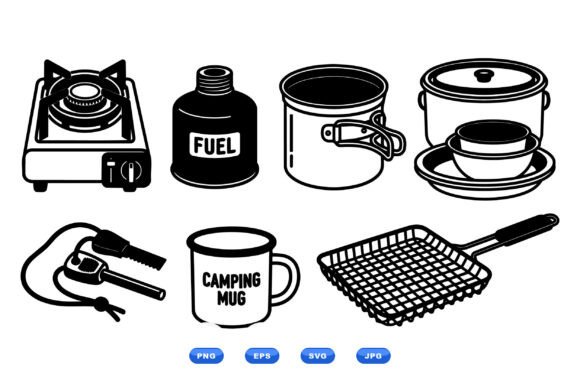
Camping Cookware Clipart Set
A Minimalist Line Art Set That Stitches Clean — But Only If You Respect Its Limits
I tested the Camping Cookware Clipart Set last week while prepping a custom embroidered tote for a local outdoor gear boutique. Their request? A subtle, gender-neutral motif for reusable bags sold at trailhead kiosks and farmers’ markets — nothing cutesy, nothing cluttered, just clean visual shorthand for “we love real cooking in the wild.” That’s exactly where this set shines: as quiet, confident design assets for makers who value restraint over repetition.
First Impression: Quiet Confidence, Not Visual Noise
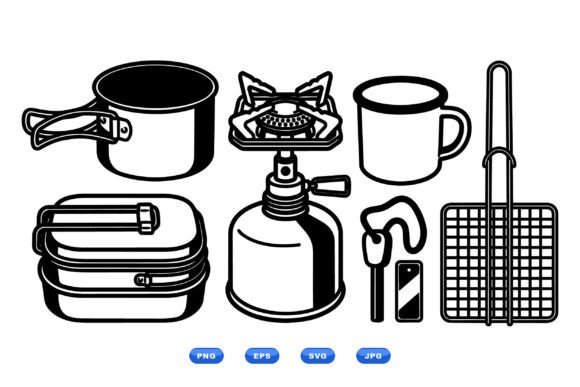
The Camping Cookware Clipart Set lands like a breath of fresh air — crisp, uncluttered, and unmistakably functional. These aren’t illustrated scenes or stylized icons with shadows or gradients. They’re precise line art vectors: a compact stove, a fuel canister with subtle valve detail, a nested pot-and-lid combo, a shallow frying pan, a camp mug with handle curve just right, and a simple grill grate. No fill, no ornamentation — just intentional strokes. That minimalism isn’t lazy; it’s strategic. It means fewer stitch jumps, smoother satin stitch transitions, and far less risk of thread piling up in tight corners during machine embroidery.
Where It Lives Best: Sweatshirts, Totes, Patches, and Thoughtful Gifting
This set works beautifully on medium-weight fabrics where clarity matters more than flash. I digitized the mug icon (scaled to 2.5” wide) for a charcoal gray organic cotton sweatshirt — used a single-color black thread, medium-density satin stitch for the outline, and a light running stitch interior for subtle texture. Result? Crisp, legible, and quietly cool. Customers noticed it *without* needing to squint.
It also translated cleanly to an embroidered patch for a small-batch apron line — stitched onto twill with tear-away stabilizer. The line weight held up perfectly across curved seams and fabric folds. On tea towels? Ideal. The stove icon at 1.75” wide reads instantly against linen’s natural weave. For baby items? Use the mug or pot alone — scaled down to 1.25” — on a soft cotton onesie. It reads as gentle, not busy. And for holiday gifts or wedding favors (think: mini camping-themed kitchen bundles), pairing the canister + mug icons on a folded linen napkin adds handmade warmth without visual overload.
Where to Pause — and Why
Don’t force this set into spaces that demand density or dimension. Avoid using the full set — all six icons together — on a standard 4x4 hoop. There’s no built-in spacing logic in the vector files, so you’ll need to manually adjust kerning and clearance before digitizing. Also, skip ultra-fine details like the canister’s valve lines on stretchy fabric (think: performance knit caps) — they’ll blur or distort unless simplified further in your embroidery software.
Dark fabric? Yes — but only with high-contrast thread (white or neon yellow). Thin fabrics like voile or lightweight rayon? Add cut-away stabilizer underneath, not just tear-away. And never assume the line art will auto-translate to dense fill-stitch areas — if you want a solid mug shape instead of an outline, you’ll need to convert and test that yourself. This is a *line art vector*, not a ready-to-stitch embroidery file — a crucial distinction for Etsy sellers bundling digital embroidery files or craft business owners sourcing design assets.
What It Adds to Your Finished Product — and What It Doesn’t
Used well, the Camping Cookware Clipart Set lifts perceived value. It signals intentionality — that the maker chose *this* visual language because it fits the product’s purpose. Customers trust subtlety. A clean stove icon on a handmade pillow cover says “designed for real use,” not “decorative afterthought.” That builds brand consistency for small shops leaning into outdoor, minimalist, or functional aesthetics.
But it won’t carry emotional weight on its own. It doesn’t tell a story — it hints at one. So pair it thoughtfully: with hand-lettered text (“Simmer Slowly,” “Fuel the Adventure”), or alongside other nature-adjacent motifs (a pine branch, a compass rose) — but don’t expect it to do heavy lifting solo. As a standalone motif on a baby onesie? Perfect. As the sole graphic on a large tote bag? Consider adding a tiny anchor or trail marker for balance.
Practical Designer Notes Before You Stitch
- Always test on scrap fabric first — especially if stitching on textured weaves or curved surfaces like caps.
- Check thread color contrast early: what reads clearly on white may vanish on oatmeal or charcoal.
- Review stitch density manually — line art vectors often digitize too lightly for apparel unless adjusted.
- Confirm hoop size compatibility before finalizing layout — some icons scale beautifully; others get fragile below 1.5”.
- Inspect small details like the mug handle connection or canister valve — they may need slight thickening for stability.
- Test in black-and-white mockups to verify silhouette recognition — does the pot still read as a pot without shading?
- Compare light and dark fabric backgrounds side-by-side before sending to production.
- Use proper stabilizer: cut-away for knits, tear-away for stable wovens, fusible for lightweight linens.
- Verify licensing — since this is a Graphics product in the Crafts category, confirm whether commercial use (e.g., selling finished embroidered totes or digital embroidery files) is permitted before listing on Etsy or in your shop.
The Camping Cookware Clipart Set won’t wow with complexity — and it’s not meant to. It earns its place by doing one thing exceptionally well: offering honest, scalable, stitch-friendly line art for makers who believe good design starts with knowing when *not* to add more.